
A first-year reliability assessment covering the V-6, transmission, recalls, maintenance, warranty, and long-term ownership risks
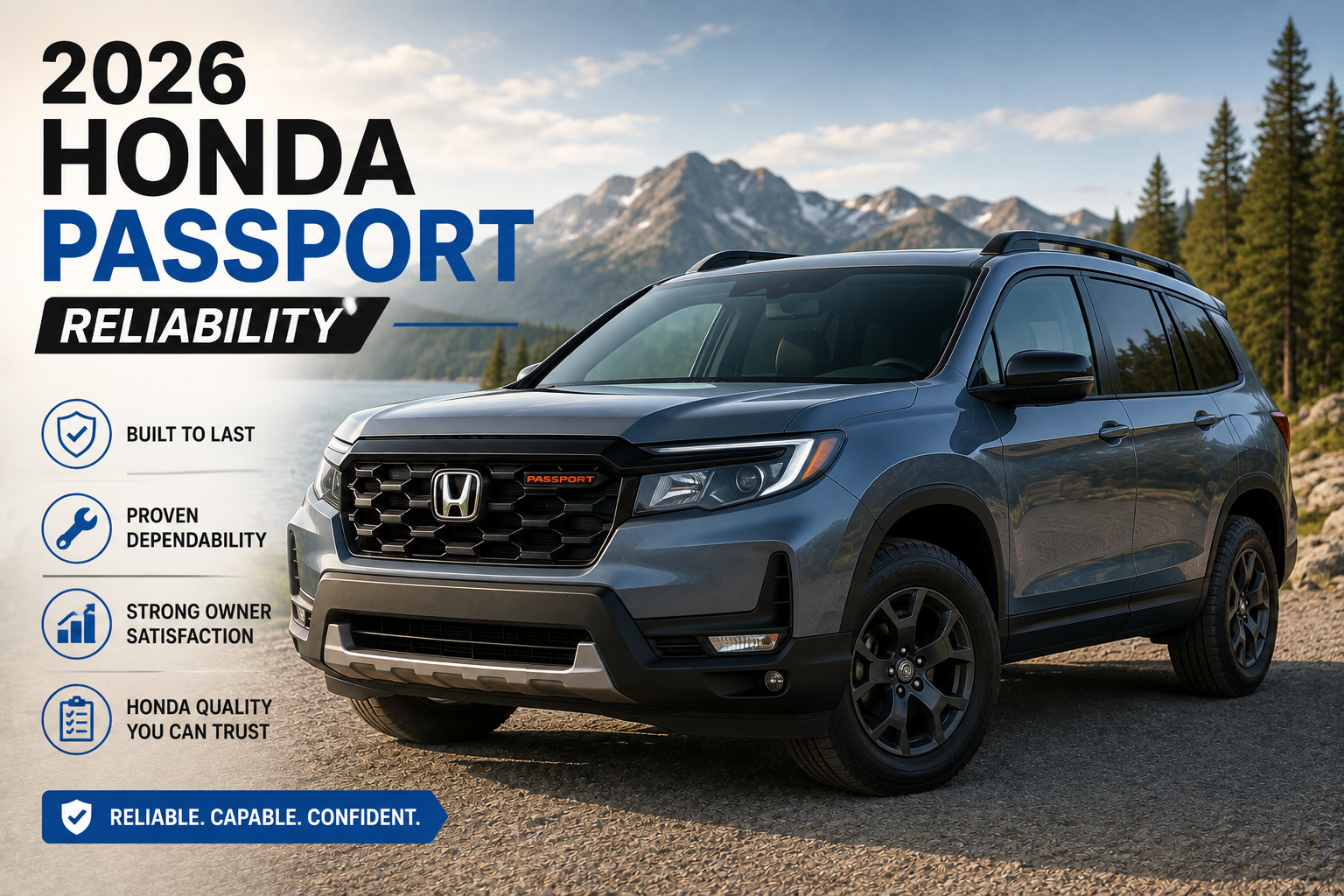
The early outlook for 2026 Honda Passport reliability is cautiously positive, but there is not yet enough high-mileage data for a confident long-term verdict. The 2026 Passport is a complete redesign with a new body, revised all-wheel-drive system, updated electronics, and a 10-speed automatic. Its naturally aspirated 3.5-liter V-6 is less complex than many turbocharged alternatives, but first-year production issues remain possible.
For buyers, the most accurate answer is that the mechanical foundation looks promising while the redesigned vehicle itself is still being proven. The Passport has already earned strong crash-test results, and its main engine and transmission concepts are familiar within Honda’s larger SUV family. However, a July 2026 recall involving rear subframe bolts shows why VIN checks and thorough delivery inspections are important.
Key Takeaways
| • The 2026 Passport is too new for meaningful ten-year or 150,000-mile reliability evidence.
• Its 285-hp naturally aspirated V-6 avoids turbochargers and hybrid hardware, which may appeal to buyers seeking a conventional powertrain. • The 10-speed automatic and i-VTM4 all-wheel-drive system add capability but require correct fluid service and careful evaluation during a test drive. • A rear-subframe-bolt recall affects a limited group of vehicles built in May 2026, so every buyer should check the VIN. • Honda provides a 3-year or 36,000-mile basic warranty and a 5-year or 60,000-mile powertrain warranty. • Waiting for more owner data may reduce first-year risk, but a properly inspected and recall-cleared 2026 model can still be a reasonable purchase. |
How Reliable Is the 2026 Honda Passport Expected to Be?
The expected reliability is above average in concept, but unproven in real-world duration. Honda chose a naturally aspirated V-6 instead of a small turbocharged engine, a plug-in hybrid, or an air-suspension system. That keeps the powertrain relatively conventional for a modern midsize SUV.
The uncertainty comes from everything surrounding that engine. The 2026 model uses a newly designed body, different suspension tuning, updated software, larger displays, Google built-in services, additional cameras, revised driver-assistance technology, and a new generation of torque-vectoring all-wheel drive. Even when major mechanical parts are familiar, connectors, sensors, modules, trim pieces, seals, and assembly processes can create first-year problems.
| Reliability Evidence | What It Suggests | Confidence Level |
| Naturally aspirated V-6 | Fewer forced-induction components than a turbo engine | Moderately reassuring |
| Honda 10-speed automatic | Established transmission concept used in other Honda vehicles | Moderately reassuring |
| All-new 2026 platform and body | Limited long-term field history for this exact Passport | Important unknown |
| IIHS Top Safety Pick+ result | Strong crash structure and crash-prevention performance | High for safety, not mechanical durability |
| One current VIN-specific recall | An assembly issue occurred in a limited production range | Confirmed and repairable |
| Owner complaints and forum reports | Useful for spotting patterns but not proof of a widespread defect | Low unless supported by official data |
Is the 3.5-Liter V-6 a Good Reliability Choice?
The Passport’s 3.5-liter DOHC V-6 produces 285 horsepower and 262 lb-ft of torque. It uses direct fuel injection and does not rely on turbochargers. For drivers planning long ownership, that simpler airflow system can be attractive because there are no turbocharger bearings, boost-control hardware, or intercooler plumbing to maintain.
Naturally aspirated does not mean maintenance-free. The engine still depends on clean oil, correct coolant, functioning emissions equipment, direct-injection components, sensors, and a scheduled timing-belt service when the Maintenance Minder calls for it. Buyers who tow, idle frequently, drive in extreme heat, or make repeated short trips should follow the vehicle’s Maintenance Minder and discuss severe-use service with a qualified Honda technician.
The main positive is predictability. The engine delivers power without the extra heat and pressure associated with a highly boosted four-cylinder. The tradeoff is fuel economy. Regular Passport trims are rated around 21 mpg combined, while TrailSport versions are rated around 20 mpg combined.
Should Buyers Worry About the 10-Speed Automatic?
The 10-speed automatic is not an experimental transmission, but the calibration is new to this Passport generation. More gears can improve acceleration and highway efficiency, yet they can also produce frequent shifting or occasional hesitation if software and driver expectations do not align.
During a test drive, the transmission should move from Park to Drive and Reverse without a long delay, pull away smoothly, downshift predictably, and avoid shuddering or harsh impacts. Test it when cold, in low-speed traffic, on a highway merge, and during a hill start. One unusual shift does not prove a defect, but repeated clunks, warning messages, slipping, or surging should be documented before purchase.
| System | Early Risk Level | What Owners Should Monitor |
| V-6 engine | Low to moderate | Oil level, warning lights, cold-start noises, leaks, and consistent maintenance |
| 10-speed automatic | Moderate | Shift quality, hesitation, software updates, and fluid-service reminders |
| i-VTM4 AWD | Moderate | Rear differential service, tire matching, vibration, and warning lights |
| Infotainment and cameras | Moderate | Screen resets, audio interruptions, camera availability, and software updates |
| TrailSport tires and suspension | Moderate | Uneven wear, alignment, noise, and off-road damage |
| Body seals and trim | Unknown | Water leaks, wind noise, loose panels, and tailgate operation |
What Recall Affects Some 2026 Passport SUVs?
As of August 3, 2026, Honda has announced a safety recall for certain 2026 Pilot and Passport vehicles because rear subframe bolts may not have been tightened correctly during assembly. The Passport population covers 1,799 vehicles produced from May 4 through May 15, 2026.
Loose bolts could cause abnormal noise, reduced stability, or partial or complete rear subframe detachment in a severe case. Dealers will inspect the affected vehicles and tighten or replace the bolts as necessary at no charge. Honda reported no related U.S. warranty claims, injuries, or deaths as of June 25, 2026.
Before buying or taking delivery, enter the VIN in the NHTSA recall lookup. A recall does not automatically make every 2026 Passport unreliable, but an open recall should be completed and documented before the vehicle is used normally.
Does the First Model Year Create Extra Risk?
Yes, although the size of that risk is impossible to quantify yet. First-year models can experience assembly corrections, software updates, supplier changes, and minor fit-and-finish issues that become less common after manufacturers collect field data.
The Passport’s risk is partly reduced because it shares engineering with Honda’s larger Pilot family and uses familiar powertrain concepts. Still, the exact body, wheelbase, cargo area, suspension setup, electronics, and off-road hardware are new. Buyers who dislike uncertainty may prefer to wait for a later model year or purchase after the vehicle has accumulated a longer reliability record.
What Maintenance Will Matter Most for Long Life?
| Maintenance Area | Why It Matters |
| Engine oil and filter | Protects the V-6, variable valve timing, bearings, and internal surfaces |
| Transmission fluid | Supports shift quality and heat control, especially with towing or mountain driving |
| Rear differential fluid | Important for the torque-vectoring all-wheel-drive system |
| Tire rotation and alignment | Reduces uneven wear and stress on the AWD system |
| Brake fluid and cooling system | Protects braking performance and temperature control |
| Timing belt and water-pump inspection | A major scheduled service that should not be ignored when the Maintenance Minder calls for it |
| Software updates and recalls | Can correct control-module behavior and safety-related defects |
Honda uses a Maintenance Minder rather than a simple one-size-fits-all mileage chart. Owners should keep every service invoice, especially for oil, transmission fluid, differential fluid, and major scheduled work. Complete records help with warranty discussions and resale value.
How Strong Are the Warranty and Safety Results?
Honda’s warranty is competitive with many mainstream brands but shorter than Hyundai and Kia coverage. The new-vehicle limited warranty lasts 3 years or 36,000 miles, and the powertrain warranty lasts 5 years or 60,000 miles. Car and Driver also reports complimentary scheduled maintenance for 1 year or 12,000 miles.
Current trim, powertrain, towing, and equipment details can be checked on the official Honda Passport specifications page. Every 2026 Passport uses a 285-hp V-6, a 10-speed automatic, standard i-VTM4 all-wheel drive, and a 5,000-pound maximum towing rating.
The redesigned Passport earned a 2026 IIHS Top Safety Pick+ award. It received good overall evaluations in the updated moderate-overlap and side tests, along with strong front crash-prevention performance. These results support occupant protection, but they do not predict long-term mechanical reliability.
What Should You Inspect Before Buying a 2026 Passport?
- Check the VIN for open recalls and confirm completed repair documentation.
- Start the vehicle cold and listen for unusual engine, exhaust, or accessory-drive noises.
- Test the 10-speed automatic at parking-lot speed, during firm acceleration, and on the highway.
- Operate the touchscreen, Google built-in functions, cameras, audio system, wireless phone connection, and every driver-assistance feature.
- Inspect the headlamps, paint, weather seals, tailgate, underbody, recovery hooks, skid plates, wheels, and tires.
- Drive over uneven pavement and listen for suspension clunks, rattles, or body noises.
- Request a written out-the-door price and confirm the warranty in-service date.
Who Should Buy Now, and Who Should Wait?
| Buy a 2026 Passport Now If You… | Consider Waiting If You… |
| Want a naturally aspirated V-6 and standard AWD | Require proven high-mileage reliability data |
| Value cargo space, towing, and genuine TrailSport capability | Prefer hybrid fuel economy |
| Can verify the VIN and complete a careful inspection | Want to avoid any first-year redesign risk |
| Plan to keep detailed service records and follow Maintenance Minder | Change vehicles often and worry about early depreciation |
| Receive a fair price and strong dealer support | Are uncomfortable with new-model recalls or software updates |
Frequently Asked Questions
Is the 2026 Honda Passport a reliable SUV?
It appears promising, but it is too new for a proven long-term rating. The conventional V-6 is encouraging, while the first-year redesign adds uncertainty.
Does the 2026 Passport have a turbo engine?
No. It uses a naturally aspirated 3.5-liter V-6 rated at 285 horsepower.
What transmission does the 2026 Passport use?
Every trim uses a 10-speed automatic transmission with standard i-VTM4 all-wheel drive.
Has the 2026 Passport been recalled?
Yes. A limited group built in May 2026 is included in a rear-subframe-bolt recall. Buyers should check the exact VIN.
Does the Passport use a timing belt?
Honda’s Maintenance Minder includes timing-belt replacement and water-pump inspection as a scheduled maintenance item. Follow the vehicle-specific reminder and warranty manual.
Is the TrailSport less reliable than the RTL?
The core powertrain is the same. TrailSport models add all-terrain tires, skid plates, an off-road suspension tune, and more equipment, which can increase wear or repair cost if the vehicle is used aggressively.
Should I avoid the first model year?
Not necessarily. A recall-cleared vehicle with a clean inspection and strong warranty support may be a good purchase, but waiting provides more owner data and time for production improvements.
The Bottom Line
The 2026 Honda Passport has the ingredients of a durable midsize SUV: a naturally aspirated V-6, a conventional automatic transmission, standard all-wheel drive, strong safety results, and a practical two-row body. Its main weakness is uncertainty, not evidence of widespread failure.
Because this is the first year of a full redesign, buyers should check the VIN, complete all recalls, test every electronic and mechanical system, and keep strict maintenance records. Those steps cannot guarantee reliability, but they reduce avoidable risk while the new Passport builds its long-term history.