
A used-buyer playbook for pricing, trims, inspections, mileage, and the old-generation vs. new-generation decision
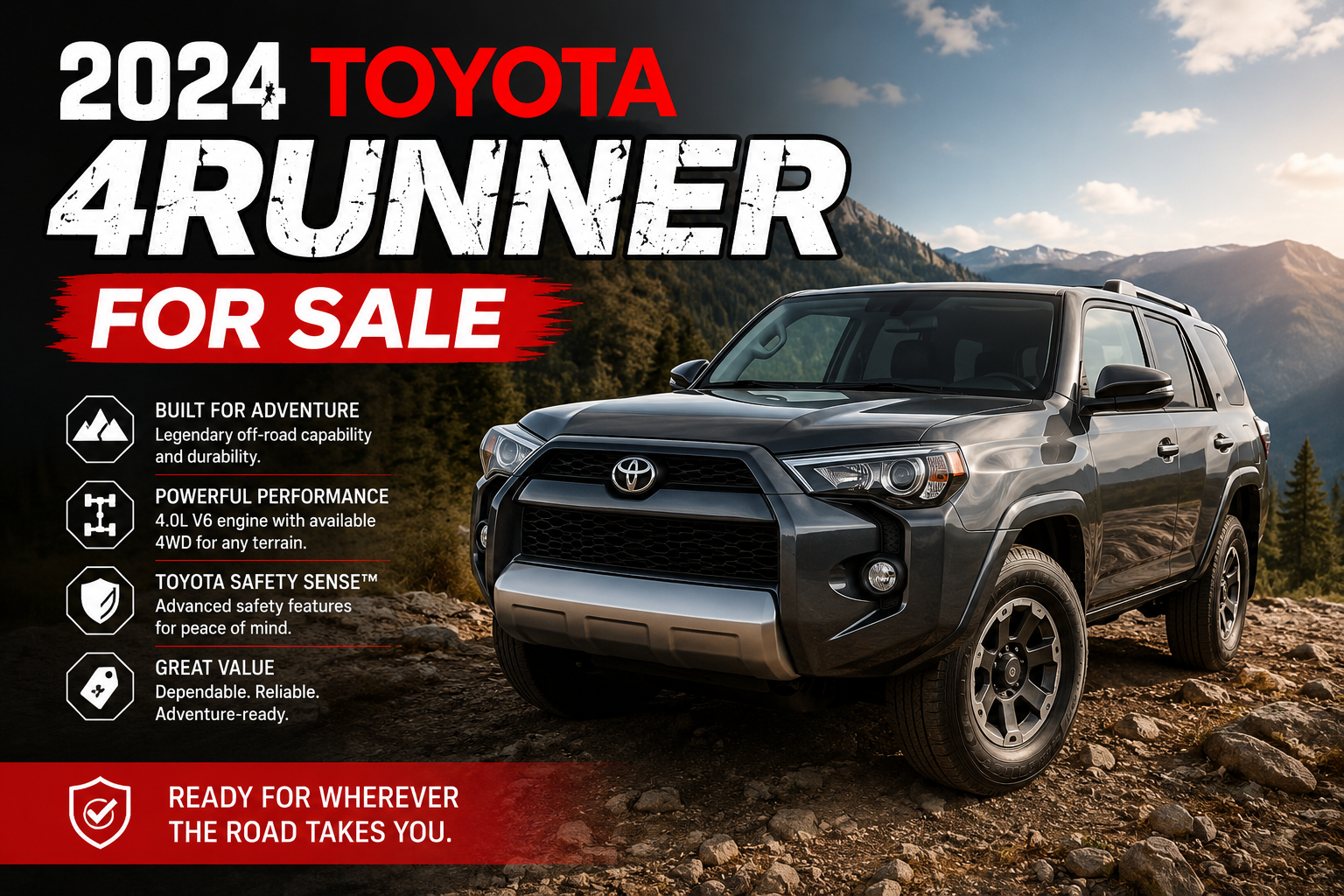
Searching for a 2024 Toyota 4Runner for sale in 2026 is different from shopping for an ordinary two-year-old SUV. The 2024 model was the final model year of the long-running fifth-generation 4Runner, and clean examples still carry unusually strong resale values. That creates a strange market: a used 2024 SR5 can cost only a few thousand dollars less than the starting price of a brand-new 2026 4Runner, while TRD Pro models can still command prices well above some new 4Runner trims.
That does not make a 2024 model a bad buy. For shoppers who specifically want the naturally aspirated 4.0-liter V6, the simple five-speed automatic, proven fifth-generation platform, and traditional 4Runner character, it can be exactly the right vehicle. The key is paying for condition and history rather than paying a nostalgia premium.
| 270 hp
4.0L V6 |
5,000 lb
Max towing |
17 mpg
EPA combined |
5 or 7
Seats |
Key Takeaways
- A typical 2024 4Runner still sells for strong money in 2026, with national dealer fair-purchase estimates ranging from the upper $30,000s for an SR5 to the mid-$50,000s for a TRD Pro.
- Every 2024 4Runner uses a 270-hp 4.0-liter V6 and five-speed automatic. Fuel economy is modest at about 16 mpg city, 19 highway, and 17 combined.
- TRD Off-Road and TRD Pro trims are the best fit for serious trail use, while Limited is the more road-oriented premium choice.
- A pre-purchase inspection matters more than low mileage alone. Look closely for off-road damage, underbody impacts, rust, fluid leaks, uneven tire wear, and poorly installed modifications.
- Because a new 2026 4Runner starts a little above $42,000 before destination and options, buyers should compare the used 2024 price directly with a new sixth-generation model before signing.
What Does a 2024 Toyota 4Runner Cost in 2026?
Used pricing moves by ZIP code, mileage, condition, accident history, drivetrain, color, and dealer fees, so no national number should be treated as a guaranteed transaction price. Still, current valuation data gives shoppers a useful negotiation range.
In early August 2026, Kelley Blue Book showed national fair-purchase pricing of roughly $37,500 for a 2024 SR5 and about $54,600 for a TRD Pro, with the other trims falling between those points. These figures represent typical dealer purchase prices and are updated regularly, not a promise of what any individual vehicle should cost.
| 2024 Trim | Approx. 2026 Fair Purchase Price | Buyer Take |
| SR5 | $37,500 | Best entry point if condition is strong |
| TRD Off-Road | $38,700 | Strong value for genuine trail hardware |
| SR5 Premium | $40,600 | Comfort upgrade without full Limited pricing |
| TRD Sport | $41,200 | Road-focused styling and X-REAS suspension |
| TRD Off-Road Premium | $42,900 | Trail capability plus more comfort |
| Limited | $46,700 | Premium cabin and available full-time 4WD |
| TRD Pro | $54,600 | Most collectible, but often the hardest to justify |
Pricing note: A one-owner truck with low mileage, desirable color, complete service records, and no accident history can list above these figures. A vehicle with higher mileage, prior damage, rental or fleet history, rust, or heavy modifications should usually trade at a discount.
Why Are 2024 4Runners Still So Expensive?
The 2024 model sits in a rare position. It is both a late-production example of a very mature generation and the last 4Runner sold with the old 4.0-liter V6. The fifth-generation design dates back to the 2010 model year, which sounds like a disadvantage, but for some buyers it is the reason to shop for one. Its mechanical layout is familiar, its aftermarket is enormous, and many owners prefer its straightforward controls and naturally aspirated engine.
Resale strength also matters. 4Runners have historically held value well, so two years of age does not automatically create the large discount buyers may expect from a mainstream SUV. The result is a market where depreciation can be shallow, especially for TRD models with clean histories.
Which 2024 4Runner Trim Should You Shop For?
SR5: Best for buyers who want the 4Runner basics
The SR5 is usually the smartest target for shoppers who want body-on-frame toughness, V6 power, cargo room, and available four-wheel drive without paying for off-road equipment they may never use. It can also be configured with a third row, making it one of the more practical versions for occasional seven-passenger duty.
SR5 Premium: Better daily-driver comfort
SR5 Premium adds comfort and convenience features that make a noticeable difference in everyday ownership. For buyers who plan to keep the vehicle for years, the premium over a base SR5 can be easier to justify than jumping all the way to Limited.
TRD Sport: The pavement-oriented choice
TRD Sport is the oddball of the range in a useful way. It has the rugged look but is tuned more for on-road use, including Toyota’s X-REAS suspension system. It makes sense for shoppers who want 4Runner styling and capability but spend most of their time commuting, traveling, and driving on pavement.
TRD Off-Road and TRD Off-Road Premium: The sweet spot for trail use
These are the trims many enthusiasts should shop first. Toyota equipped the TRD Off-Road family with hardware such as an electronic locking rear differential, Crawl Control, and Multi-Terrain Select. That gives them meaningful off-road capability without the high used-market premium attached to a TRD Pro.
Limited: Best for road trips and mixed-weather driving
Limited trades some of the trail-first character for a more upscale road experience. Its available full-time four-wheel-drive system uses a Torsen center differential, and the trim includes more comfort equipment. It is the better fit for snow-belt commuting and long-distance driving when extreme trail hardware is not the priority.
TRD Pro: Buy it because you specifically want a TRD Pro
The TRD Pro adds the strongest factory off-road image and specialized hardware, including upgraded suspension and trail-focused equipment. It also carries the largest resale premium. In 2026, shoppers should be especially disciplined here because a lightly used TRD Pro can cost as much as, or more than, some new sixth-generation 4Runner configurations.
What Are the Core 2024 Toyota 4Runner Specs?
| Specification | 2024 4Runner |
| Engine | 4.0-liter naturally aspirated V6 |
| Output | 270 hp and 278 lb-ft of torque |
| Transmission | 5-speed automatic |
| Drivetrains | Rear-wheel drive or four-wheel drive, depending on trim |
| EPA fuel economy | About 16 city / 19 highway / 17 combined mpg |
| Maximum towing | 5,000 pounds |
| Ground clearance | About 9.0 inches on 2WD models and 9.6 inches on 4WD models |
| Seating | Five standard, with an available third row on selected trims |
| Infotainment | 8-inch touchscreen with wired Apple CarPlay and Android Auto |
Toyota’s official 2024 model information confirms the V6 output, 5,000-pound tow rating, seven-trim lineup, and standard Toyota Safety Sense P driver-assistance suite across the range.
Should You Buy a Used 2024 or a New 2026 4Runner?
This is the most important comparison in the current market. The 2026 4Runner is a sixth-generation vehicle with turbocharged four-cylinder power, an eight-speed automatic, newer infotainment, newer driver-assistance technology, and available hybrid power. Toyota currently lists the 2026 4Runner with a starting MSRP a little above $42,000 before destination, options, taxes, and dealer charges.
You can check current new-model pricing and specifications on Toyota’s official 2026 4Runner page.
| Decision Point | 2024 Used 4Runner | 2026 New 4Runner |
| Powertrain | 4.0L V6, 5-speed automatic | 2.4L turbo, 8-speed automatic; hybrid available |
| Character | Old-school, proven, simple | More modern, quicker, more refined |
| Fuel economy | About 17 mpg combined | Up to low-20s combined, depending on configuration |
| Technology | 8-inch screen, older safety suite | Newer multimedia and Toyota Safety Sense 3.0 |
| Warranty | Remaining factory coverage depends on in-service date and mileage | Full new-vehicle warranty |
| Price logic | Best when discounted enough for age and mileage | Can be the better value when used pricing is unusually high |
The practical rule: If the used 2024 you want is only a few thousand dollars below a comparable new 2026 model after dealer fees, financing, and warranty are considered, the new vehicle deserves a serious look. If you specifically want the fifth-generation V6, the 2024 can still be worth a premium, but that is a preference decision rather than a pure value decision.
What Should You Inspect Before Buying a 2024 4Runner?
A clean-looking 4Runner can hide expensive wear. Because many 4Runners are used for towing, camping, trail driving, and aftermarket modification, a pre-purchase inspection is especially valuable.
- Frame and underbody: Look for dents, scraped skid plates, bent brackets, corrosion, fresh undercoating that may hide rust, and damage around recovery points.
- 4WD operation: On a 4WD model, verify that the transfer case shifts correctly and that the applicable 4WD modes engage without warning lights or abnormal noises.
- Differential and off-road systems: On TRD Off-Road and TRD Pro models, confirm the locking rear differential and electronic trail systems operate correctly.
- Suspension: Check for leaking shocks, clunks, uneven ride height, worn bushings, and irregular tire wear. Modified suspension deserves extra scrutiny.
- Tires: Four matching tires with even tread are preferable. Aggressive off-road tires can hide alignment issues and may add road noise or braking distance.
- Engine and transmission: The V6 should idle smoothly, pull consistently, and shift without harsh engagement. Inspect for fluid seepage and evidence of neglected maintenance.
- Accident and paint history: Panel gaps, paint overspray, mismatched paint, replaced lamps, or fresh trim can indicate previous body repair.
- Aftermarket parts: Lift kits, wheels, bumpers, roof racks, lights, and wiring can add value only when installed correctly. Poor modifications can create reliability, alignment, or electrical problems.
How Many Miles Is Too Many for a 2024 4Runner?
Mileage should be judged in context. A 2024 model with 45,000 highway miles, complete maintenance records, original paint, and no off-road abuse may be a better purchase than a 20,000-mile example with accident repairs and questionable modifications. At this age, roughly 12,000 to 15,000 miles per year is a useful reference point, but there is no magic cutoff.
Higher mileage should translate into a lower price. More importantly, compare the odometer with tire age, brake wear, service history, interior wear, and the vehicle’s reported use. A seller who cannot explain a large mileage discrepancy or missing service history gives you leverage to walk away.
Does a 2024 4Runner Still Have Factory Warranty Coverage?
Possibly. Toyota originally covered the 2024 4Runner with a 3-year/36,000-mile basic warranty and a 5-year/60,000-mile powertrain warranty. Whether coverage remains depends on the original in-service date, mileage, and the specific repair. A late-2024 delivery with low mileage may still have meaningful factory coverage in 2026.
Ask a Toyota dealer to confirm warranty status by VIN. Do not assume a dealer’s phrase such as ‘still under warranty’ means every component is covered.
How Do You Check a 2024 4Runner for Open Recalls?
Always run the exact VIN before purchase. Recall status is vehicle-specific, and a model-year search cannot tell you whether a particular truck has already received a repair. The federal NHTSA recall lookup lets U.S. shoppers enter a VIN or license plate to check for unrepaired safety recalls. NHTSA notes that recall repairs are completed free of charge by the manufacturer.
How Can You Negotiate a Better Deal on a 2024 4Runner?
- Compare at least three similar listings with the same trim, drivetrain, mileage band, and accident history.
- Negotiate the out-the-door price, not only the monthly payment.
- Ask for the vehicle history report and service records before discussing financing.
- Use worn tires, upcoming brakes, missing keys, body damage, or overdue maintenance as specific price adjustments.
- Do not pay a TRD Pro-style premium for an SR5 that has been modified to look like one.
- Get a separate pre-approval from a bank or credit union so you can compare the dealer’s financing on equal terms.
- If the price is close to a new 2026 4Runner, request a written new-vehicle quote before deciding.
Frequently Asked Questions
Is the 2024 Toyota 4Runner a good used SUV?
It can be an excellent used SUV for buyers who value durability, off-road ability, towing capacity, cargo space, and the fifth-generation V6 powertrain. Its weaknesses are equally clear: poor fuel economy, dated technology, a truck-like ride, and used prices that can remain high.
Which 2024 4Runner is best for off-roading?
TRD Off-Road, TRD Off-Road Premium, and TRD Pro are the main targets. The TRD Off-Road trims usually offer the strongest value because they include genuine trail hardware without the same collector-style premium as TRD Pro.
Is the 2024 4Runner good for families?
It works well for families that prioritize cargo space, durability, outdoor use, and towing. Selected SR5, SR5 Premium, and Limited models were available with a third row, but the third row is best treated as occasional seating rather than a spacious adult solution.
Is a 2024 4Runner worth more because it has the V6?
For some buyers, yes. The final-year V6 and mature fifth-generation platform have created extra demand. That does not mean every V6 example is worth an inflated price. Condition, service history, trim, mileage, and accident history should still determine what you pay.
What is the biggest downside of buying one in 2026?
The biggest downside is the value equation. A clean 2024 can be expensive enough that a new 2026 4Runner offers better technology, fuel economy, financing options, and warranty coverage for a manageable increase in total purchase price.
The Bottom Line: Buy the History, Not Just the Badge
A 2024 Toyota 4Runner for sale in 2026 can be one of the better ways to buy the final version of the fifth-generation SUV, but only if the price reflects its age, mileage, and condition. The best buys are not automatically the lowest-mileage trucks or the most expensive TRD models. They are the vehicles with clean histories, documented maintenance, sensible modifications, healthy tires and suspension, and a price that leaves enough daylight between used and new.
For most shoppers, an SR5 Premium or TRD Off-Road Premium offers the most balanced combination of equipment and resale value. For dedicated trail users, TRD Off-Road is often the smarter value than TRD Pro. And for buyers who mainly drive on pavement, a Limited or even a new 2026 4Runner may make more financial sense.
Before purchase, compare current national values with local listings, inspect the vehicle independently, verify the VIN for recalls and warranty status, and calculate the full out-the-door cost. That approach is far more useful than deciding based on the asking price alone.