
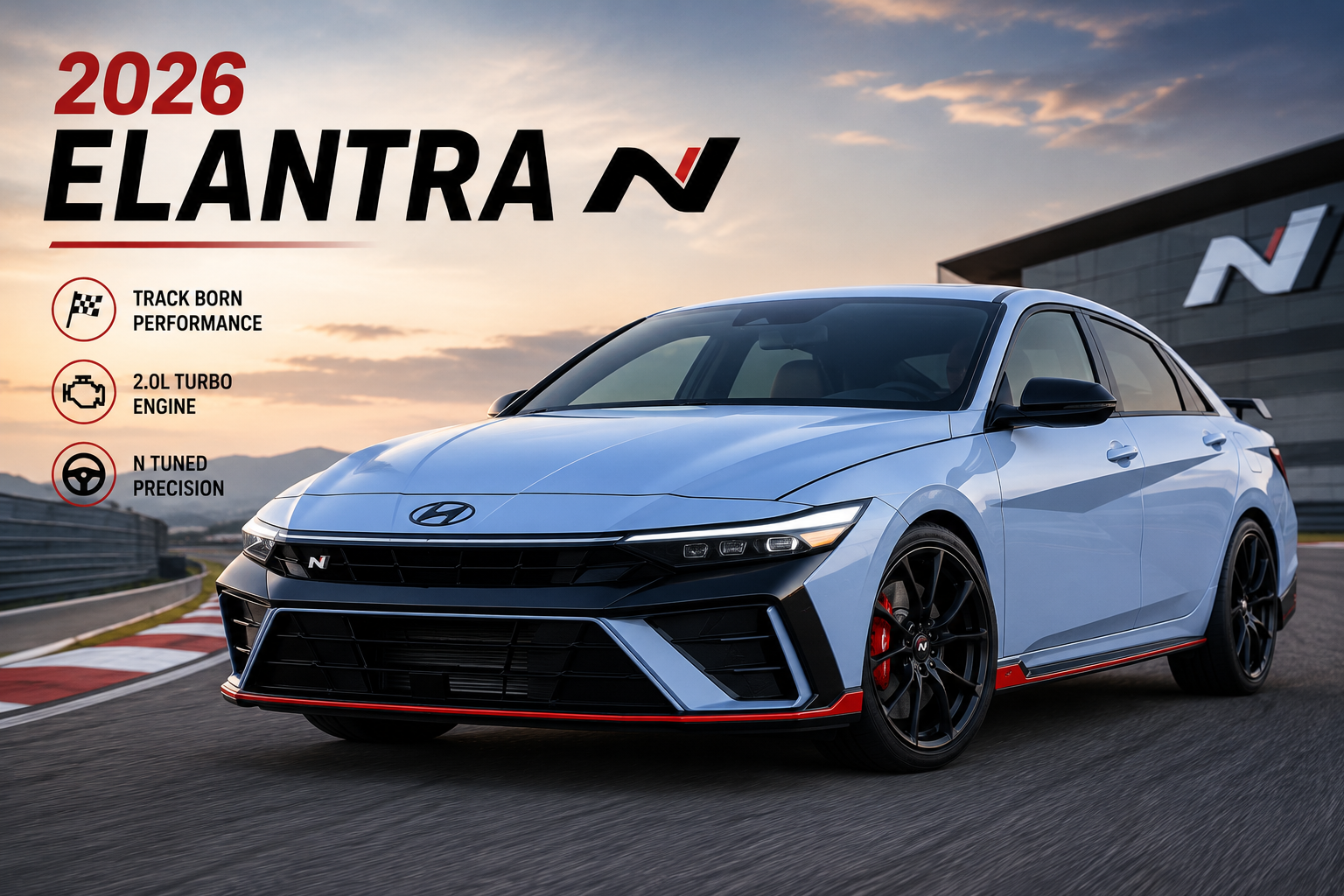
Manual versus DCT, track hardware, TCR Edition upgrades, acceleration, fuel economy, daily usability, and the best configuration
| 2026 Elantra N fact | Details |
| Vehicle type | Front-wheel-drive compact performance sedan |
| Engine | Turbocharged 2.0-liter four-cylinder |
| Output | 276 horsepower and 289 lb-ft of torque |
| Transmissions | Six-speed manual or eight-speed wet dual-clutch automatic |
| Temporary DCT boost | Up to 286 horsepower with N Grin Shift |
| Base MSRP | $35,100 before freight, tax, title, and license |
| Delivered starting price | Approximately $36,345 based on current listed pricing |
| EPA economy, manual | 21 mpg city, 29 mpg highway, 24 mpg combined |
| EPA economy, DCT | 20 mpg city, 27 mpg highway, 23 mpg combined |
| Cargo and seating | Five seats and 14.2 cubic feet of trunk space |
| Warranty | Five years or 60,000 miles basic; 10 years or 100,000 miles powertrain for the original owner |
| Verdict in 30 seconds
The Elantra N remains one of the best performance values on sale. It combines a strong turbo engine, real front-axle differential, adaptive dampers, large brakes, track-capable cooling, a loud adjustable exhaust, and a practical four-door body for roughly the price of a well-equipped ordinary sedan. Choose the manual for engagement and the DCT for maximum acceleration. |
2026 Elantra N is a rare car that can handle commuting, family errands, back-road driving, and track days without requiring major modifications. Its front-wheel-drive layout creates some limits compared with AWD rivals, but Hyundai uses an electronically controlled limited-slip differential and carefully tuned suspension to turn the car into a sharp, adjustable sports sedan.
The 2026 model is mostly unchanged mechanically, which is not a weakness. Hyundai already refreshed the exterior and chassis for 2024. The significant addition is the limited TCR Edition, which adds more serious brakes, forged wheels, Alcantara details, and a large adjustable rear wing without increasing engine output.
2026 Pricing and Versions
| Version | Working price | Main advantage | Best buyer |
| Six-speed manual | About $36,345 delivered | Maximum driver involvement | Enthusiast who enjoys shifting |
| Eight-speed DCT | Higher than manual, depending on final sticker | Fastest acceleration and N Grin Shift | Daily driver or drag-strip buyer |
| TCR Edition | Approximately $42,495 listed range ceiling | Brakes, forged wheels, aero, exclusivity | Track-focused collector |
Hyundai lists the standard car at $35,100 before freight and other charges. Hyundai’s official 2026 Elantra N page confirms the 276-hp turbo engine, 289 lb-ft of torque, standard 19-inch wheels, N Light Sport bucket seats, electronically controlled suspension, and N Corner Carving Differential.
Engine and Performance
The turbocharged 2.0-liter four-cylinder produces 276 horsepower and 289 lb-ft. Premium fuel is required to achieve the maximum advertised output. Regular fuel can be used, but Hyundai states that horsepower may be reduced.
Manual cars use a close-ratio six-speed gearbox with automatic rev matching. DCT models use an eight-speed wet dual-clutch transmission and gain N Grin Shift, which temporarily raises output to 286 horsepower and sharpens the powertrain response.
| Measured result | DCT | Manual | What it means |
| 0 to 60 mph | 4.8 seconds | About 5.1 to 6.1 seconds depending on test method | DCT launches more consistently |
| Quarter-mile | 13.4 seconds at 106 mph | 13.8 seconds at 103 mph in prior testing | Strong performance for the price |
| Skidpad grip | 0.96 g in prior test | 0.99 g in prior test | Serious summer-tire capability |
| 70 to 0 mph | 161 feet | 156 feet | Track-ready braking for a compact sedan |
The supplied Car and Driver Elantra N review rates the car 10 out of 10 and recorded a 4.8-second run to 60 mph with the DCT. The review praises the sharp handling, strong engine, expressive exhaust, and real-world fuel efficiency, while noting occasional low-speed DCT clunkiness and the absence of adaptive cruise control.
Why the Front-Wheel-Drive Chassis Works
The electronically controlled limited-slip differential actively sends more torque to the outside front wheel during cornering. This reduces inside-wheel spin and helps the car rotate rather than pushing wide. The system is one of the main reasons the Elantra N feels more serious than an ordinary front-wheel-drive sport trim.
Adaptive dampers allow the driver to choose a more livable street setting or a firmer track setting. Steering weight, differential response, stability control, engine mapping, transmission behavior, and exhaust sound can also be adjusted through customizable N modes.
| It is not only a straight-line car
The Elantra N’s value comes from its cooling, brakes, differential, dampers, tires, and adjustability. A less expensive sedan with similar horsepower may not deliver the same repeatable track performance. |
Manual or DCT?
| Decision point | Manual | DCT |
| Engagement | More involving and satisfying | Fast but less mechanical |
| Acceleration | Slower launch | 4.8-second tested 0 to 60 mph |
| Traffic | Requires clutch work | Easier, but can feel clunky at low speed |
| Track use | More driver input and heat simplicity | Faster shifts and N Grin Shift |
| Fuel economy | 24 mpg combined | 23 mpg combined |
| Best choice | Weekend and back-road enthusiast | Daily driver seeking maximum pace |
The manual is the emotional choice and may become more desirable as new manual performance cars disappear. The DCT is the objective performance choice. It accelerates faster, shifts more consistently, and is easier to live with in traffic.
What Does the TCR Edition Add?
The limited TCR Edition does not increase power. Its value comes from track-focused hardware, including forged wheels, upgraded front brakes with four-piston monoblock calipers, a large adjustable carbon rear wing, Alcantara cabin touch points, and blue seat belts.
The lighter wheels reduce unsprung mass, which can improve steering response and suspension control. The larger brake package may provide better heat capacity during repeated hard laps. The wing is visually dramatic and potentially useful at track speeds, but it also makes the car less subtle for daily use.
Fuel Economy and Real-World Range
The manual is EPA-rated at 21 mpg city, 29 mpg highway, and 24 mpg combined. The DCT is rated at 20/27/23 mpg. Those numbers are modest, but highway testing has been surprisingly strong.
Car and Driver recorded 32 mpg with a manual and 37 mpg with a DCT on its 75-mph highway route. Results depend heavily on speed, traffic, tire pressure, temperature, and how frequently the turbocharger is used.
Interior, Cargo, and Daily Comfort
The Elantra N remains a practical sedan. It has four doors, a roomy rear seat, and 14.2 cubic feet of trunk space. Hyundai lists 99.4 cubic feet of passenger volume, and the rear legroom is generous for the sport-compact class.
N Light Sport bucket seats provide strong support but may feel firm or narrow for some drivers. The ride can also become harsh in the stiffest setting, and the standard Michelin Pilot Sport 4S summer tires are not suitable for freezing temperatures or snow.
Technology, Safety, and Warranty
Two 10.3-inch screens provide the instrument display and infotainment interface. The car includes navigation, Bose audio, wireless charging, and wired Apple CarPlay and Android Auto. Standard safety equipment includes automatic emergency braking, blind-spot monitoring, and lane-keeping assistance.
Adaptive cruise control is not offered, which may matter to highway commuters. Hyundai’s warranty remains a major strength: five years or 60,000 miles of basic coverage, 10 years or 100,000 miles of powertrain coverage for the original owner, and three years or 36,000 miles of complimentary maintenance.
How It Compares With Rivals
| Rival | Why it may be better | Why the Elantra N may be better |
| Honda Civic Type R | Sharper ultimate track tool and hatchback utility | Costs roughly $12,000 more |
| Honda Civic Si | Lower price, better fuel economy, smoother ride | Far more power and stronger track hardware |
| Volkswagen Golf GTI | Hatchback versatility and refined daily manners | Manual availability and more aggressive chassis |
| Volkswagen Golf R | AWD traction and more premium cabin | Much lower price and livelier personality |
| Toyota GR Corolla | AWD and rally-style character | More rear-seat room and lower starting price |
| Volkswagen Jetta GLI | Comfort, efficiency, and lower price | Substantially more power and track capability |
Who Should Buy It?
- A driver who wants one car for commuting and occasional track days
- A manual-transmission enthusiast who still needs four doors
- A performance buyer who cannot justify Civic Type R pricing
- A driver who values adjustable chassis settings and exhaust sound
- A buyer comfortable purchasing dedicated winter tires in a cold climate
Skip it when a soft ride, quiet cabin, AWD traction, adaptive cruise control, or luxury interior materials matter more than performance. The Elantra N is highly capable, but it is intentionally loud, firm, and attention-grabbing.
Frequently Asked Questions
How much is the 2026 Elantra N?
Hyundai lists a $35,100 MSRP before freight and fees. Current delivered pricing begins around $36,345, while the DCT and limited TCR Edition cost more.
How much horsepower does it have?
The engine produces 276 horsepower and 289 lb-ft. DCT models can temporarily reach 286 horsepower with N Grin Shift.
Is it AWD?
No. Every Elantra N is front-wheel drive with an electronically controlled limited-slip differential.
Which transmission is faster?
The eight-speed DCT is faster and reached 60 mph in 4.8 seconds in testing. The manual provides more involvement.
Does it require premium fuel?
Premium fuel is required to achieve the maximum advertised 276 horsepower. Regular fuel may reduce output.
Final Verdict
The 2026 Hyundai Elantra N remains one of the strongest new-car performance bargains in the United States. It is genuinely fast, highly adjustable, track capable, and practical enough for daily use, all while starting in the mid-$30,000 range.
Choose the manual for maximum engagement, the DCT for the quickest acceleration, and the TCR Edition only when its brakes, forged wheels, aero, and rarity justify the cost. For most buyers, the standard car is already complete.